
What is an industrial wind turbine?
An industrial wind turbine is far more than a windmill — it is an autonomous electric power production plant capable of self-management. Modern wind turbines continuously monitor wind conditions, orient themselves to face the wind, regulate their power output, protect themselves from extreme weather, and communicate with centralized SCADA systems — all without human intervention.
The dominant design in the industry is the HAWT (Horizontal Axis Wind Turbine) with 3 blades in an upwind configuration (blades face into the wind, ahead of the tower). This design offers the best compromise between aerodynamic efficiency, structural loads, visual impact, and noise emissions.
Anatomy of a wind turbine
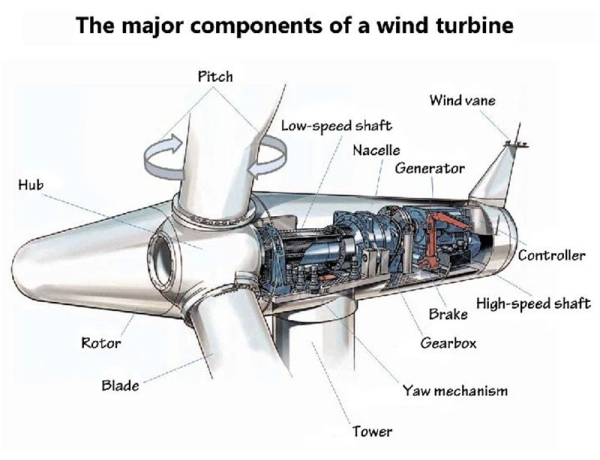
The image above shows the internal layout of a typical wind turbine with a squirrel cage induction generator. Key components include the rotor hub, main shaft, gearbox, generator, yaw system, and the nacelle enclosure that protects all internal machinery from the elements.
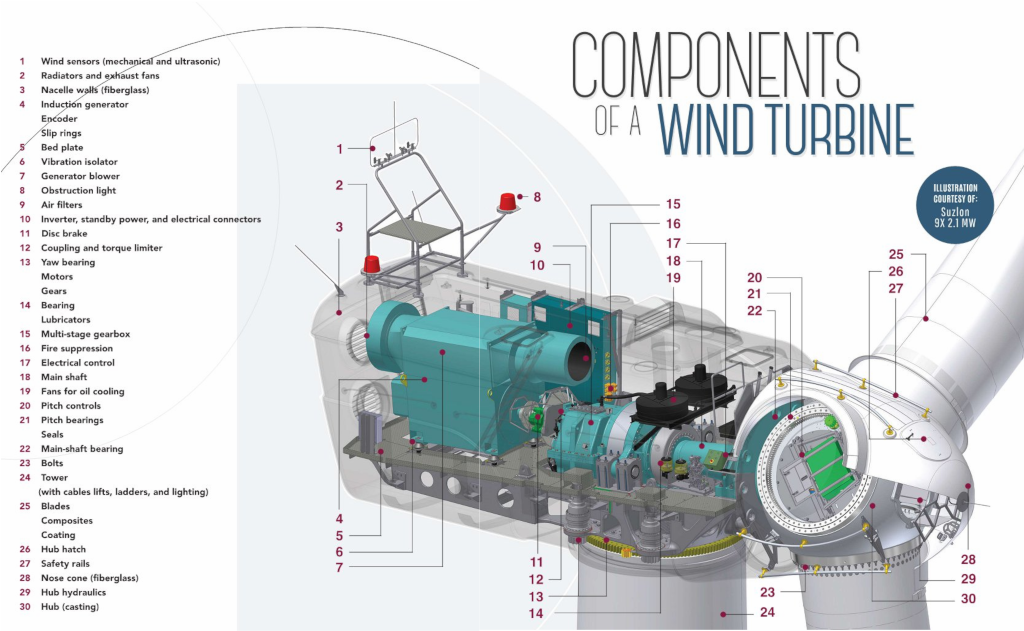
The DFIG configuration, shown above, is the most widely installed type today. It features a wound rotor induction generator connected to a partial power converter (Back-to-Back), enabling variable speed operation and reactive power control.
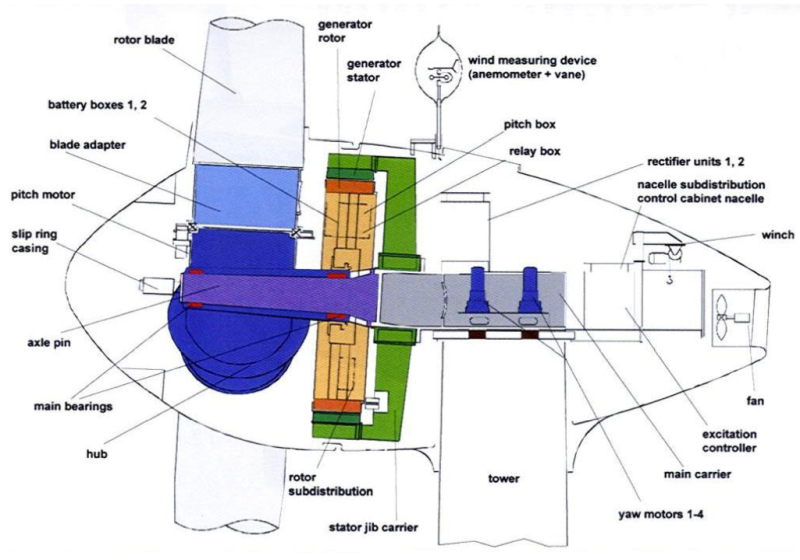
The Enercon design eliminates the gearbox entirely, coupling the rotor directly to a large-diameter synchronous generator. A full-power converter handles 100% of the electrical output, providing maximum flexibility in grid interaction.
Fundamental physics
Nominal power and rotor size
The nominal power of a wind turbine is proportional to the square of the blade radius. Doubling the blade length quadruples the swept area and, consequently, the energy capture potential. This relationship is the primary driver behind the industry trend toward ever-larger rotors.
Power equation
P = ½ · ρ · A · v³ · Cp
Where P is power, ρ is air density, A is swept area (πR²), v is wind speed, and
Cp is the power coefficient (theoretical maximum: 0.593, Betz limit).
Wind speed: the cubic relationship
The available wind power is proportional to the cube of wind speed. This means that a modest 25% increase in wind speed (e.g., from 8 to 10 m/s) nearly doubles the available power. This cubic relationship explains why site selection and hub height are so critical to project economics.
Air density effects
Air density directly affects power output and is influenced by three factors:
- Humidity — Higher humidity slightly reduces air density (water vapor is lighter than nitrogen and oxygen).
- Atmospheric pressure — Higher altitude means lower pressure and less dense air, reducing power output. A wind farm at 1,000 meters elevation produces approximately 10% less power than an equivalent sea-level site.
- Temperature — Colder air is denser and carries more energy. Winter months typically yield higher production even at the same wind speeds.
Wind gust tolerance
Wind gust tolerance is a key design parameter that significantly differentiates wind turbine families. The ability to withstand and continue operating during sudden wind speed variations determines the turbine's structural loads, control strategy, and ultimately its suitability for different wind regimes. More advanced turbine families offer better gust support through variable speed operation and fast pitch control.
Current industry ranges
| Parameter | Onshore | Offshore |
|---|---|---|
| Nominal power | 3 – 7 MW | 8 – 21 MW |
| Rotor diameter | 120 – 175 m | 180 – 260 m |
| Hub height | 80 – 170 m | 100 – 150 m |
| Blade length | 55 – 85 m | 85 – 125 m |
| Tower type | Steel tubular / hybrid concrete-steel | Steel tubular / jacket / monopile |
The trend toward larger machines is driven by economics: larger rotors capture more energy per installed MW, reducing the Levelized Cost of Energy (LCOE). However, logistics constraints (blade transport, crane availability) create practical limits for onshore installations, which is why the most extreme sizes are reserved for offshore projects.
Try our real-time simulators
Free 2-day evaluation — experience wind turbine operation hands-on
Download simulators