
Learning by doing
ACMSL's real-time simulators are designed for practical skills acquisition. Unlike static presentations or textbook exercises, our simulators reproduce the actual behavior of industrial wind turbines in real time, allowing trainees to develop intuition and operational skills in a safe, controlled environment.
Each simulator includes integrated tutorials with step-by-step practical exercises that guide the learner from basic concepts to advanced operational scenarios. The tutorials are designed to be self-paced, allowing professionals to learn at their own rhythm.
The 4 simulators
We recommend following the simulators in the order presented below. Each one builds on the concepts learned in the previous one, creating a progressive and coherent learning experience.
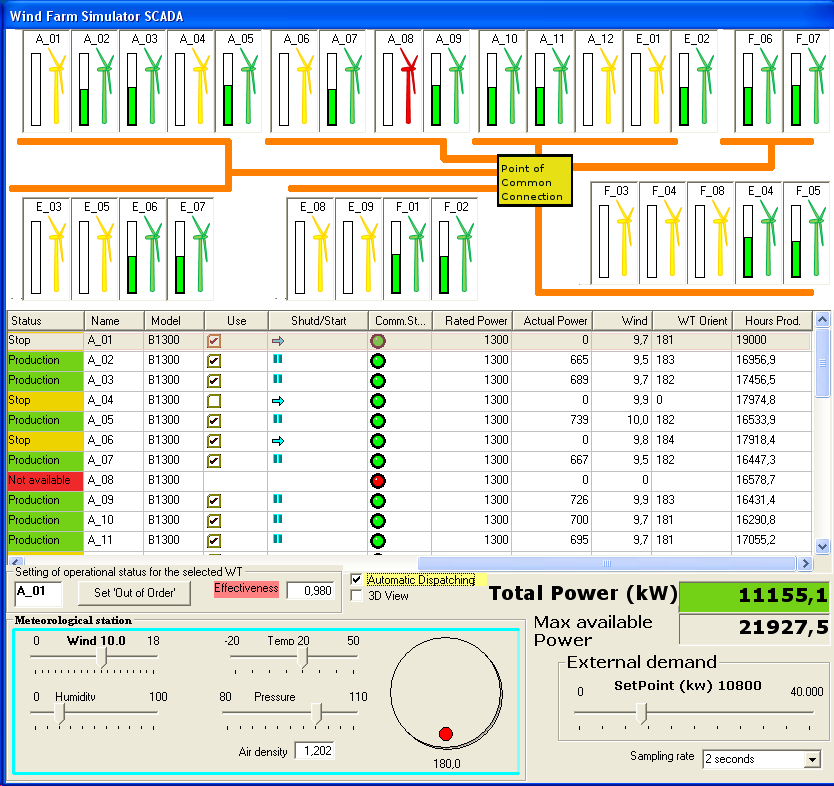
1. Wind Farm SCADA Control Center
Start with the big picture. This simulator reproduces a complete wind farm control center, including multiple wind turbines, an electrical substation, meteorological tower, and grid connection point. Learn how a wind farm operates as a system: production monitoring, alarm management, remote control, and grid interaction.
Key topics: SCADA interface, wind farm topology, substation operations, power dispatch, alarm hierarchies, meteorological data interpretation.
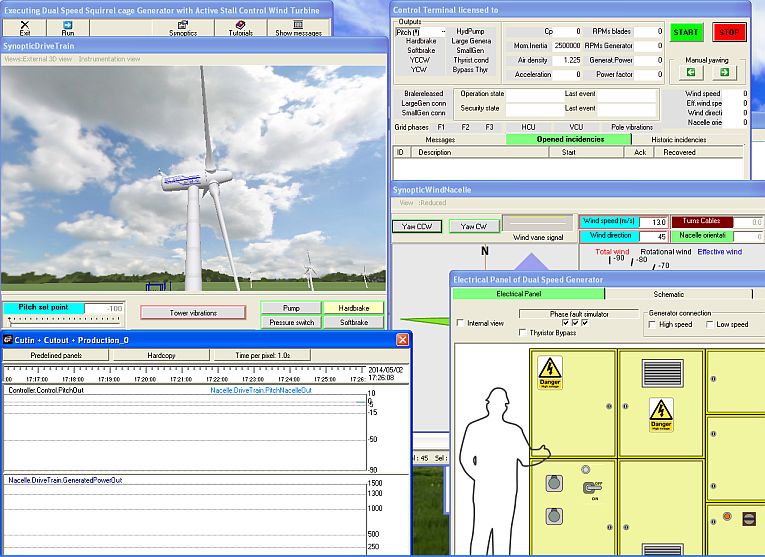
2. Dual Speed Active Stall (DSAS)
Master the fundamentals. This simulator models a Family 2 wind turbine with dual-speed squirrel cage induction generator and active stall pitch control. It is the ideal starting point for understanding core wind turbine concepts without the complexity of power electronics.
Key topics: Cut-in/cut-out sequences, dual-speed switching, active stall regulation, yaw control, safety system hierarchy, operational wind thresholds, power limitation.
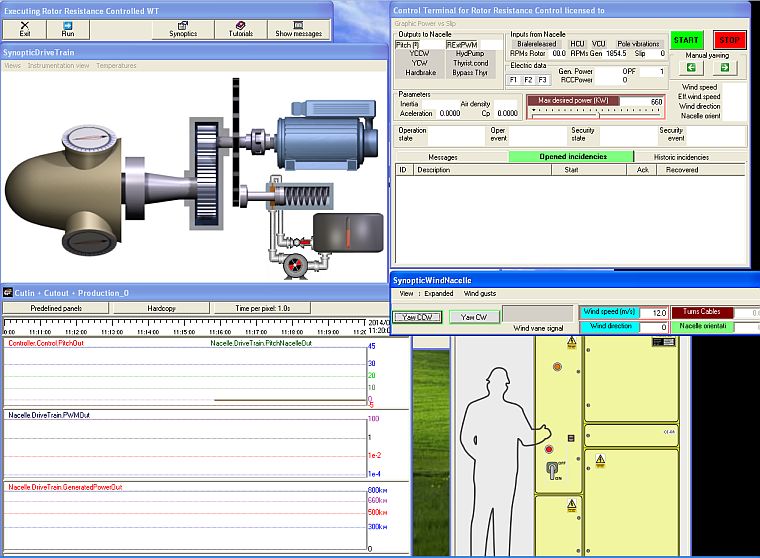
3. Rotor Resistance Controller (RRC)
Understand variable speed. This simulator models a Family 3 wind turbine with wound rotor induction generator and variable rotor resistance. Learn how controlled speed variation improves energy capture and provides wind gust tolerance — the key innovation that paved the way for modern DFIG designs.
Key topics: Variable rotor resistance control, speed-torque characteristics, wind gust absorption through kinetic energy, slip control, energy dissipation management.
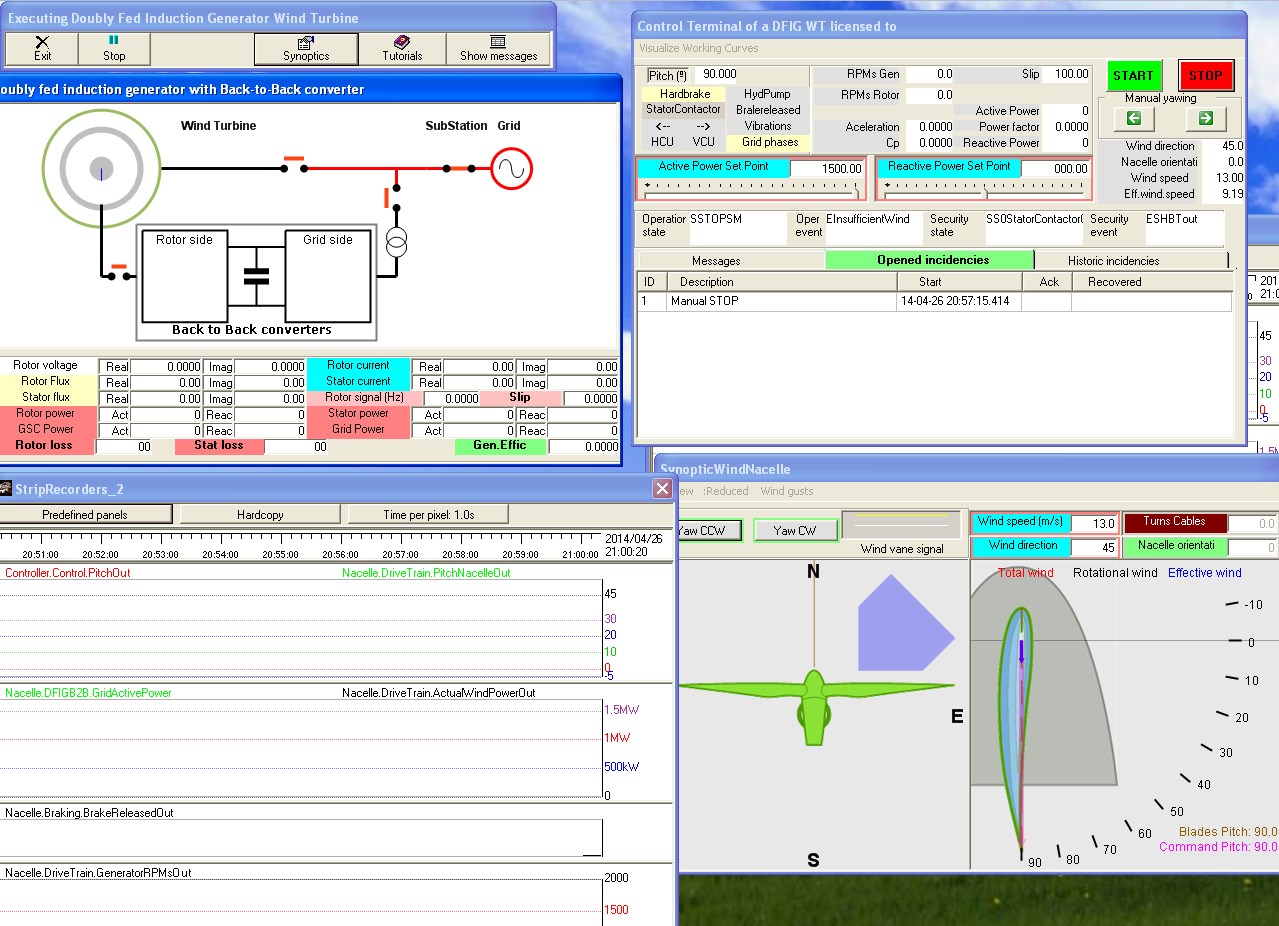
4. DFIG Wind Turbine
Master the industry standard. This simulator models the most widely installed wind turbine family: the Doubly-Fed Induction Generator. Understand how the Back-to-Back converter controls active and reactive power independently, enabling full grid support capabilities and compliance with modern grid codes.
Key topics: Back-to-Back converter operation, active/reactive power control, grid code compliance, crowbar protection, MPPT (Maximum Power Point Tracking), voltage regulation, frequency response.
Engineering tools
In addition to the simulators, ACMSL provides specialized engineering tools for deeper technical analysis:
Operational Curve Calculator (MPPT)
Design and analyze the optimal power-speed operating curve for variable-speed wind turbines. This tool calculates the Maximum Power Point Tracking (MPPT) curve based on the turbine's aerodynamic characteristics, allowing engineers to understand how optimal tip-speed ratio translates into real-world operating points.
Applications: MPPT curve design, energy yield estimation, partial load optimization, comparison of different control strategies.
DFIG Back-to-Back Analyzer
Analyze the electrical behavior of the DFIG Back-to-Back converter in detail. This tool provides visualization and analysis of rotor-side and grid-side converter operation, including current vectors, power flows, and the relationship between mechanical speed, electrical frequency, and slip.
Applications: Converter sizing, power flow analysis, reactive power capability assessment, operating point verification.
What makes our simulators different
Real-time simulation
Our simulators run in real time, reproducing the actual temporal behavior of wind turbines. When you command a pitch change, the blades take the same time to rotate as in a real machine. When wind changes, the rotor inertia responds with realistic time constants. This temporal fidelity is essential for developing operational intuition.
Integrated tutorials
Each simulator includes comprehensive tutorials that combine theory and practice. You read about a concept, then immediately apply it in the simulator. This learn-then-do approach dramatically accelerates skill acquisition compared to classroom-only training.
Safe learning environment
Mistakes in a real wind turbine can cause equipment damage worth hundreds of thousands of euros or endanger lives. Our simulators allow trainees to explore boundary conditions, trigger alarms, and even crash the turbine — all without consequences. Learning from failure is one of the most effective training methods, and simulation makes it safe.
Professional-grade fidelity
The physical models behind our simulators are based on established electrical machine theory, aerodynamic models, and control system engineering. The simulators reproduce phenomena that professionals encounter in real operations: generator magnetization, torque oscillations, grid voltage fluctuations, and wind turbulence effects.
Try our real-time simulators
Free 2-day evaluation — full access to all 4 simulators and engineering tools
Download now