
Classification criteria
Industrial wind turbines are classified into 5 families based on two key design choices: the blade pitch control mechanism (how the blades regulate aerodynamic power) and the generator type and grid connection (how electrical power is produced and delivered to the grid). Understanding these families is essential for any wind energy professional, as each family has distinct operational characteristics, control strategies, and grid interaction capabilities.
Family 1: Fixed Pitch + Squirrel Cage (directly connected)
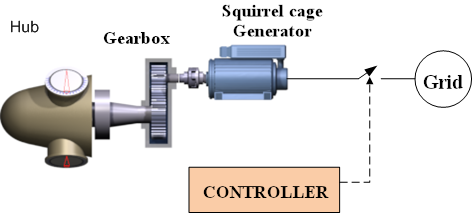
The earliest industrial wind turbines used fixed pitch blades (also called stall-regulated) combined with a squirrel cage induction generator (SCIG) connected directly to the grid. These machines relied on the natural aerodynamic stall phenomenon to limit power in high winds.
- Typical power range: up to 300 kW
- Era: 1980s – early 1990s (historical)
- Advantages: Extremely simple and robust design, low manufacturing cost, minimal control electronics
- Limitations: Poor energy capture efficiency, no ability to support wind gusts, fixed speed operation causes high mechanical loads, no reactive power control, significant power quality issues
Family 2: Active Stall + Squirrel Cage (directly connected)
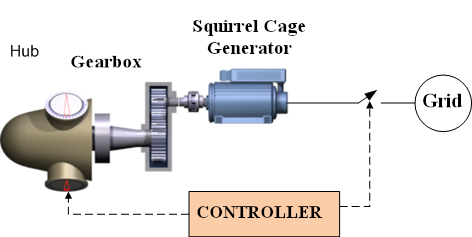
The active stall design introduces variable pitch blades that rotate toward stall (increasing the angle of attack) to regulate power. The generator remains a squirrel cage induction machine directly connected to the grid, often with dual speed capability (two separate windings for low and high wind speeds).
- Typical power range: 600 – 1,300 kW
- Era: 1990s – 2000s, still manufactured for specific markets
- Advantages: Good cost-to-production ratio for stable wind sites, proven reliability, pitch control adds safety and regulation capabilities
- Limitations: Still essentially fixed speed, limited gust support, no reactive power control, dual-speed switching creates transient loads
Why start learning here?
Family 2 turbines are the ideal starting point for training. Their relatively straightforward control system — combining pitch regulation with a directly-connected generator — allows learners to grasp fundamental concepts (power regulation, speed thresholds, yaw control, safety systems) without the complexity of power electronics. The ACMSL Dual Speed Active Stall (DSAS) simulator is designed for exactly this purpose.
Family 3: Variable Pitch + Variable Rotor Resistance
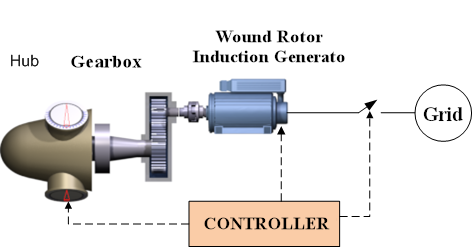
This family uses a wound rotor induction generator (WRIG) with external resistors connected to the rotor circuit. By varying the rotor resistance, the generator's torque-speed characteristic can be modified, allowing limited variable speed operation (typically from synchronous speed to +10% above synchronous speed).
- Typical power range: 1,500 – 1,800 kW
- Era: Late 1990s – 2000s
- Technology example: Vestas OptiSlip system
- Advantages: Moderate wind gust support through speed variation, better energy capture than fixed-speed designs, reduced mechanical stress during gusts
- Limitations: Energy dissipated as heat in the rotor resistors, limited speed range, no reactive power control capability
The bridge to modern designs
Family 3 represents the engineering compromise between simplicity and performance. Learning its control strategy — especially how rotor resistance modulation absorbs wind gusts — provides crucial insight into why the industry moved toward more advanced converter-based solutions. The ACMSL Rotor Resistance Controller (RRC) simulator teaches these concepts hands-on.
Family 4: DFIG — Doubly-Fed Induction Generator
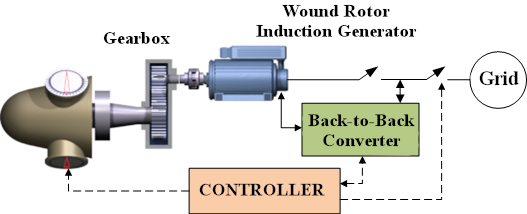
The DFIG is the most common wind turbine family in the global installed fleet. It uses a wound rotor induction generator where the stator is directly connected to the grid while the rotor is fed through a Back-to-Back (B2B) power converter. Because the converter only handles the slip power (approximately 30% of nominal power), it is significantly smaller and cheaper than a full-power converter.
- Typical power range: 1.5 – 3 MW (and beyond)
- Era: 2000s – present, still the most installed family
- Advantages:
- Wide variable speed range (±30% around synchronous speed)
- Excellent wind gust support through kinetic energy absorption
- Full reactive power control (4-quadrant operation)
- Grid support capabilities (voltage regulation, frequency response)
- Cost-effective: converter handles only ~30% of power
- Limitations: Requires slip rings and brushes (maintenance), crowbar protection during grid faults, more complex control system
The industry workhorse
Understanding DFIG technology is arguably the most important skill for wind energy professionals. The interaction between stator flux, rotor currents, and the B2B converter creates a fascinating and powerful control system. The ACMSL DFIG simulator provides a comprehensive training environment for mastering this technology, including reactive power management and grid code compliance.
Family 5: Full Converter
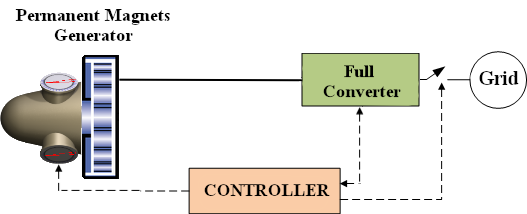
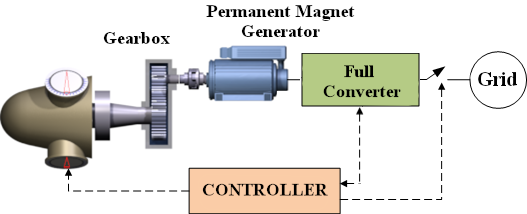
The full converter family decouples the generator completely from the grid using a power converter that handles 100% of the nominal power. This provides maximum flexibility in both generator design and grid interaction.
- Generator options:
- Permanent Magnet Synchronous Generator (PMSG) — most common in new designs
- Electrically Excited Synchronous Generator (EESG) — used by Enercon
- Squirrel cage or wound rotor asynchronous generators
- Drivetrain options:
- Direct drive (no gearbox) — large, slow-rotating generator
- Medium-speed with single-stage gearbox — compromise solution
- High-speed with multi-stage gearbox — smaller generator
- Advantages: Full speed range, complete grid decoupling, excellent fault ride-through, enables direct drive (eliminates gearbox failures), best grid support capabilities
- Limitations: Full-power converter is more expensive, higher converter losses, direct drive generators are very large and heavy
- Typical power range: 3 – 21 MW (dominant in large offshore turbines)
Comparison table
| Family | Blade Control | Generator Type | Grid Connection | Power Range | Typical Era | Key Advantage |
|---|---|---|---|---|---|---|
| 1 | Fixed pitch (stall) | Squirrel cage (SCIG) | Direct | < 300 kW | 1980s–90s | Simplicity |
| 2 | Active stall | Squirrel cage (SCIG) | Direct (dual speed) | 600–1,300 kW | 1990s–2000s | Cost/production ratio |
| 3 | Variable pitch | Wound rotor (WRIG) | Direct + rotor resistors | 1,500–1,800 kW | Late 1990s–2000s | Moderate gust support |
| 4 | Variable pitch | DFIG (wound rotor) | Partial B2B (~30%) | 1.5–3+ MW | 2000s–present | Best cost/performance |
| 5 | Variable pitch | PMSG / EESG / SCIG | Full converter (100%) | 3–21 MW | 2010s–present | Maximum flexibility |
Recommended learning path
From simple to complex
ACMSL recommends a progressive learning approach that mirrors the historical evolution of the technology:
- Start with Family 2 (Active Stall) — Master fundamental concepts: power regulation, speed thresholds, yaw control, safety systems, and SCADA interaction using the DSAS simulator.
- Progress to Family 3 (Rotor Resistance) — Learn how variable speed operation improves gust tolerance and energy capture using the RRC simulator.
- Master Family 4 (DFIG) — Tackle the most installed technology: Back-to-Back converter control, reactive power management, and grid code compliance using the DFIG simulator.
This progression builds understanding layer by layer, ensuring each new concept builds on a solid foundation.
Try our real-time simulators
Free 2-day evaluation — practice with all 3 wind turbine families
Download simulators