
The production curve
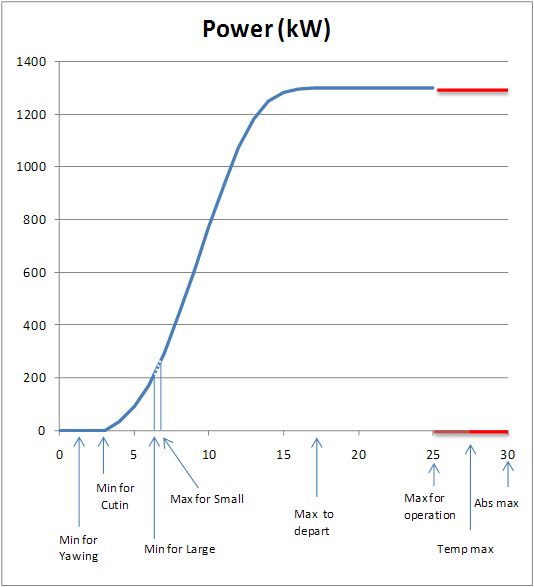
Every wind turbine has a characteristic production curve (also called a power curve) that defines the relationship between wind speed and electrical power output. This curve is not a smooth theoretical function — it is shaped by a series of discrete wind speed thresholds that trigger different operational modes and control actions.
Understanding these thresholds is fundamental for wind turbine operators, as they determine when the machine starts, stops, changes speed, and how it responds to varying wind conditions. Each threshold represents a critical decision point in the turbine's control logic.
Wind speed thresholds explained
The following table summarizes the key wind speed parameters that define a wind turbine's operational envelope. While the exact values vary by manufacturer and model, the typical ranges presented here apply to most modern industrial wind turbines.
| Parameter | Typical Value | Description |
|---|---|---|
| Min for yawing | ~2.5 m/s | Below this wind speed, automatic yaw orientation does not operate |
| Min for cut-in | ~5 m/s | Below this wind speed, the wind turbine will not attempt to start production |
| Min for Large | ~6.5 m/s | Dual-speed wind turbines: switch from high speed to low speed below this threshold |
| Max for Small | ~7 m/s | Dual-speed wind turbines: switch from low speed to high speed above this threshold |
| Max to depart | ~20 m/s | If idle and wind exceeds this, the wind turbine will not attempt a cut-in |
| Max for Operation | ~28 m/s | If sustained, the controller initiates an orderly cut-out procedure |
| Temp max | ~25 m/s | Emergency threshold: triggers a faster cut-out response than normal maximum |
| Abs max | ~30 m/s | Absolute maximum: triggers immediate cut-out (emergency stop) |
Detailed threshold analysis
Minimum for yawing (~2.5 m/s)
The yaw system orients the nacelle to face the wind direction. Below approximately 2.5 m/s, wind direction measurements become unreliable and the energy available is negligible, so the yaw system is disabled to avoid unnecessary wear on the yaw motors and bearings. The turbine simply waits, maintaining its last orientation.
Minimum for cut-in (~5 m/s)
This is the wind speed at which the turbine controller decides there is enough energy to justify starting the generator. Below this threshold, the aerodynamic torque is insufficient to overcome mechanical friction and generator magnetization losses. The cut-in sequence typically involves releasing the rotor brake, allowing the blades to accelerate, and then connecting the generator to the grid once synchronous (or near-synchronous) speed is reached.
Dual-speed thresholds: Min for Large (~6.5 m/s) and Max for Small (~7 m/s)
Dual-speed wind turbines (common in Families 1 and 2) have two separate generator windings: a small generator (fewer poles, lower power) for low winds and a large generator (more poles, higher power) for stronger winds. The gap between 6.5 and 7 m/s creates a hysteresis band that prevents the turbine from constantly switching between speeds when wind hovers around the threshold.
Practical example
Consider a 1,300 kW dual-speed turbine with a 300 kW small generator and a 1,300 kW large generator. At 6 m/s, the turbine operates on the small generator producing about 80 kW. As wind increases to 7 m/s, the controller disconnects the small generator, briefly coasts, and connects the large generator. If wind then drops to 6.8 m/s, the turbine stays on the large generator (no switch). Only when wind drops below 6.5 m/s does it switch back to the small generator. This hysteresis prevents mechanical stress from frequent switching.
Maximum to depart (~20 m/s)
This often-overlooked threshold is a safety measure. If the turbine is currently idle (not producing) and the wind speed is already above ~20 m/s, the controller will not attempt to start the machine. Starting a turbine in very high winds would create dangerous transient loads during the acceleration and grid connection phases. The turbine must wait until wind drops below this threshold before attempting a cut-in.
Maximum for operation (~28 m/s)
When the 10-minute average wind speed exceeds approximately 28 m/s, the controller initiates an orderly shutdown. The blades are pitched to feather position (minimum angle of attack), the generator is disconnected from the grid, and the rotor brake is applied. This is a controlled process designed to minimize structural loads. The turbine will automatically restart when wind drops below the cut-in threshold again.
Temporary maximum (~25 m/s)
This threshold is lower than the operational maximum and represents an emergency condition that requires a faster response. It typically corresponds to a shorter averaging period (e.g., 30-second average instead of 10-minute average) or a rapid wind speed increase. The controller executes a faster shutdown sequence compared to the normal maximum threshold.
Absolute maximum (~30 m/s)
The absolute maximum wind speed triggers an immediate emergency stop. This is typically based on instantaneous (3-second) wind speed readings. The turbine executes its fastest possible shutdown — blades pitch to full feather, generator disconnects, and the emergency brake engages simultaneously. This threshold exists to protect the turbine from structural damage during extreme wind events.
Important note
The exact values of all thresholds vary significantly between manufacturers and turbine models. They depend on the structural design, rotor diameter, tower height, and the specific wind class (IEC 61400-1) the turbine is certified for. Always consult the specific turbine's operating manual for the actual threshold values.
Practical implications for operators
Understanding these thresholds allows operators to:
- Anticipate turbine behavior — Predict when turbines will start, stop, or change operating modes based on weather forecasts.
- Diagnose anomalies — Recognize when a turbine is not responding correctly to wind conditions (e.g., failing to cut in despite adequate wind).
- Optimize production — Understand how threshold settings affect annual energy production and whether site-specific adjustments could be beneficial.
- Plan maintenance windows — Schedule maintenance during periods when wind conditions will keep the turbine idle anyway.
Try our real-time simulators
Free 2-day evaluation — see these thresholds in action during simulated operations
Download simulators